
Posted by Diane Dewell on 29th Dec 2025
How to Store Antique and Vintage Furniture: Practical Advice From Years of Real Experience
How to Store Antique and Vintage Furniture
Practical advice from years of seeing what works and what doesn’t
At Industrial Treasures, we handle antique and vintage furniture of every era and type. Wood case pieces, upholstered furniture, industrial and mixed-material pieces all pass through our hands. Much of what we see has lived several lives before it reaches us. One of the biggest factors in whether a piece survives intact or quietly loses value over time is how it was stored.
Storage is often treated like a pause button. In reality, it is an active environment. Furniture responds to it every single day.
This article is written for homeowners, people between homes, and families dealing with estates. These are moments when furniture needs to be stored quickly and decisions are often made under pressure. The goal here is not to criticize or second-guess anyone. It is to help people avoid preventable damage and understand the trade-offs involved.
Why storage is especially challenging in the Midwest
We are in the Chicago area, which means four very real storage challenges: high summer humidity, hot temperatures, cold winters, and wide seasonal temperature swings.
These conditions are not unique to the Midwest, but they do make problems show up faster. Moisture, condensation, and expansion and contraction cycles quietly damage furniture long before anything looks obviously wrong.
The most common mistake we see is underestimating how much the environment affects furniture, especially when storage is assumed to be temporary and then stretches into months or years.
The biggest risks to antique furniture
Based on decades of hands-on experience, these are the most common causes of storage damage we see.
Moisture and humidity are the biggest enemies. They lead to veneer failure, mold, rust, finish breakdown, and structural movement.
Temperature fluctuations come next. Repeated expansion and contraction stress joints, loosen veneer, and create long-term instability.
Water exposure causes sudden and often irreversible damage. Roof leaks, condensation, and ground moisture are frequent culprits. We have seen veneer finishes ruined by a single unnoticed leak.
Insects and rodents are another major issue. Mice nest in upholstery and stuffing, chew fabric, and soil furniture. Moth damage to wool rugs and textiles is very common. In barns and outbuildings, wood-boring insects are a real concern. In extreme cases, raccoons, squirrels, and even stray cats have caused damage.
Physical pressure and stacking are also a problem, especially for upholstered furniture. Compression damage does not always rebound, even if the piece looks fine at first.
Storage spaces we have used and what we learned from them
Over the years, we have stored furniture and equipment in almost every setting imaginable. Basements, climate-controlled storage units, our more than 100-year-old barn, heated and unheated warehouses, retail back rooms, trailers and shipping containers, and homes.
Basements are often damp even when they feel dry. Long-term basement storage frequently results in musty odors and moisture or even flood damage.
Climate-controlled storage units are generally the safest option for valuable furniture, especially wood and upholstery, as long as the unit is truly well maintained.
Our old barn was free of roof leaks after we replaced the roof, but it was vulnerable to humidity swings, insects, and rust. We saw both wood and metal suffer there.
Warehouses can work, especially heated ones, but without humidity control problems still develop over time.
Trailers and shipping containers carry a high condensation risk and experience extreme temperature swings.
Retail back rooms and homes can be workable for short-term storage if conditions are stable and furniture is spaced properly.
No space is perfect. The key is understanding the risks that come with each environment.
Wood furniture: strong but not indestructible
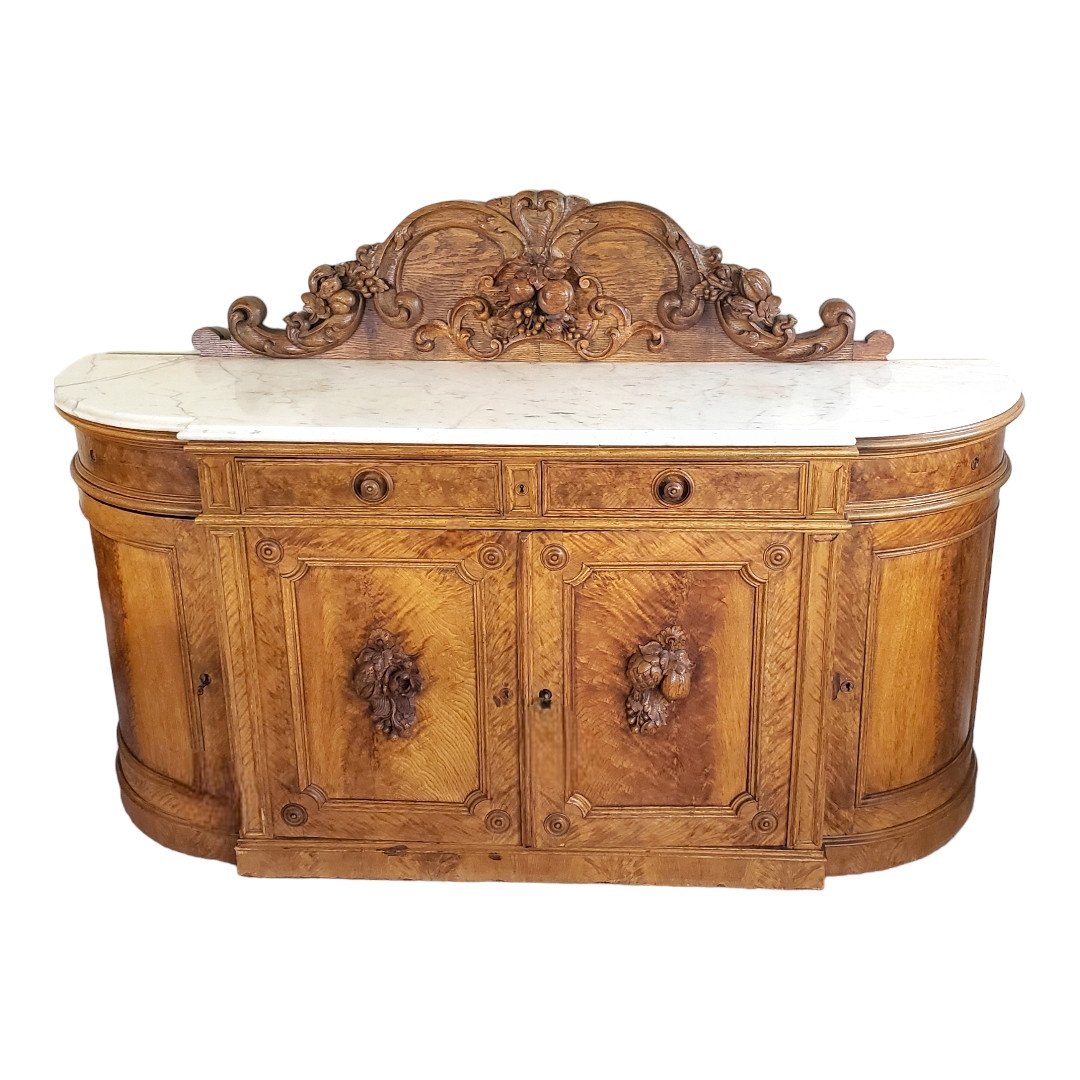
Pieces with mixed materials, like this antique buffet with a marble top, are especially sensitive to moisture and temperature changes because wood and stone respond differently to their environment.
Solid wood furniture can tolerate more than many people expect, but it has limits.
The most common problems we see are veneer lifting from moisture or leaks, joint movement from temperature swings, and insect damage when pieces are stored in barns or outbuildings.
Good practices include keeping furniture elevated off concrete floors, allowing air circulation, and avoiding plastic wrap that traps moisture. Stable conditions matter more than warmth.
Upholstered furniture: more vulnerable than it looks
Upholstered furniture is often underestimated when it comes to storage.
Stacking compresses padding and frames. Mice are attracted to stuffing. Fabric is vulnerable to insects. Feather cushions, in particular, are not as indestructible as we would like to think. Once they lose structure or are compromised by moisture or pests, they rarely fully recover.
Upholstered pieces should never be stacked. Breathable covers are better than plastic, and periodic inspection is important.
Mixed-material and industrial pieces
Furniture that combines wood, metal, leather, or upholstery reacts unevenly to storage conditions.
We have seen rust bleed from metal components stain adjacent wood, corrosion caused by barn storage, and leather dry out or crack in fluctuating environments. These pieces need balanced conditions and room to breathe.
Temporary versus long-term storage
Many storage decisions are made with the thought that the situation is temporary.
In reality, temporary storage often becomes long-term. Damage accumulates quietly, and by the time it is noticed, it is usually too late to reverse.
Even short-term storage should be approached carefully if the furniture has real value. If storage is likely to last more than a few months, it is worth reassessing whether the setup truly protects the pieces.
Doing it right versus doing it affordably
Space and budget are almost always limited. There is no one-size-fits-all answer, but there are real trade-offs.
Truly valuable furniture deserves proper storage, even for a short time. Some furniture is more forgiving than others. Good enough solutions can work if people understand the risks and are clear about their goals.
In some situations, selling rather than storing preserves more value in the long run. Storage is not always the neutral choice people hope it will be.
What we look for when buying furniture that has been stored
When we evaluate furniture, storage history often tells the real story. We regularly see furniture that’s been stored for years and condition matters more than people expect. We look for musty odors, veneer movement, rust or corrosion, insect damage, structural instability, and fabric deterioration.
Once storage damage occurs, it is usually irreversible. Every time furniture is moved and stored, it risks losing value.
Final thoughts
Storage is not passive. It affects furniture every day it sits. Thoughtful storage decisions, especially during moves or estate situations, can make a meaningful difference in whether a piece survives intact.
Understanding the risks helps people make better choices, even when conditions are not ideal. That is often the difference between preserving a piece for the next chapter and quietly losing what made it special in the first place.