
Posted by Diane Dewell on 17th Aug 2026
What's the Difference Between Antique, Vintage, and Industrial Style?
Quick version: Vintage means at least 20 years old. Antique means 100 years or older. Industrial style describes the look, not the age — materials built for utility and endurance. A piece can be industrial style and brand new, or industrial and genuinely antique, and that distinction matters more than most shoppers realize.
The Simple Age Rule That Clears Up Most Confusion
After years of standing on the sales floor answering this exact question, I've found the easiest way to explain it comes down to age.
Vintage means a piece is at least 20 years old. Antique means 100 years or older. Once you use those two numbers as a guide, the differences in style and construction start to make sense on their own, since materials and design changed a lot in the years between 20 and 100 years old.
Industrial style is different. It's not an age category at all. It describes design and materials that echo what you'd find in a factory setting, built for utility and endurance rather than decoration. Industrial style can be a brand new piece made in the spirit of factory design, while authentic industrial refers to the real thing, made decades ago for real industrial use.
Why This Distinction Matters for Your Wallet
Authentic industrial pieces are worth paying attention to as an investment. They're more likely to appreciate in value than modern furniture, because the patina on a genuine piece can't be replicated. Modern industrial-style furniture might look the part, but it doesn't carry that same history or value trajectory.
A Real Example: The China Cabinet That Fools Everyone
One of the hardest categories to sort out is reproduction furniture — pieces made to look antique that are actually vintage by age.
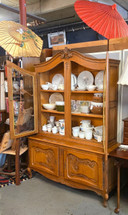
We have a carved oak china cabinet on our floor right now that's a perfect example. At just 44.5 inches wide, it's unusually compact for this type of cabinet — small enough to fit spaces where a full-size china cabinet would never work. But compact doesn't mean simple. The carved shell and scroll crest along the shaped crown, the carved medallion running down the center column between the two glass doors, and the curved feet with functional locks all reflect a maker with real decorative ambition. By appearance, almost anyone would assume it's a genuine antique. By age, it's vintage.
I don't see these reproductions as fakes. I think of them as an homage to the original designers — well-crafted pieces that carry a tradition forward even if they weren't built when the originals were.
A well-made reproduction on our floor, vintage by age but easy to mistake for a genuine antique.
Common Myths About Antique and Vintage Furniture
A few misconceptions come up constantly, and they keep people from finding pieces they'd genuinely love.
People assume antique automatically means expensive, snobbish, or a style that's too formal and uncomfortable for their home. Vintage gets confused with thrift, as if it means worn out or low quality. The collector value and design provenance behind these pieces are often misunderstood or undervalued entirely.
None of that matches reality. Antique doesn't mean formal or unaffordable, and vintage doesn't mean thrift store. What you're actually paying for is provenance, construction, and a story that mass-produced modern furniture simply doesn't have. If you have questions about specific pieces or how we price things, our FAQ covers a lot of the ground we get asked about most.
My Advice: Buy What You Love
Once you understand the categories, here's the practical part. Buy what you love.
The most interesting rooms mix various styles and genuinely captivating pieces, not furniture chosen to match a strict category. That variety is exactly what draws people to vintage and industrial shopping in the first place, and it's a far wider range than you'll ever find at a typical furniture store.
The real value difference comes down to genuine patina and durable construction — qualities that are extremely rare in anything made today.
How to Shop Smarter: What to Actually Inspect
If you're walking into a vintage or industrial store for the first time, here's how to shop like someone who knows what they're looking at.
Look everywhere, not just at eye level. Check high shelves for pieces mounted up out of easy view, and check the floor and under other items for pieces that might be tucked away.
Inspect the piece carefully. Check the joints to make sure the piece is solid, look for signs of repair, and flip it over to look at the underside — this is where you'll learn the most about a piece's history. Look for manufacturer labels, decals, or markings. Handwritten, stenciled, or rubber stamped names, dates, and style numbers all tell you about quality and workmanship, and whether a piece has been refinished or repainted.
Open the drawers. Top drawers often have manufacturer markings on the inside that won't show anywhere else.
Check the drawer construction. Are the joints dovetailed? Is the wood in the drawers the same as the rest of the piece? Sometimes it isn't. On old pieces, better wood was expensive and got saved for visible surfaces, with lesser wood used where it wouldn't show. On modern pieces, the same trick happens for the same reason, cutting cost on parts buyers won't inspect. On modern furniture, watch for masonite drawer bottoms, a sign of lower quality construction. On pieces with drawer glides, look for metal glides, ideally with ball bearing slides — cheaper cabinets sometimes use a simple wood rail down the center anchored with a plastic fitting, which won't hold up. Look for staples in the construction, generally a sign of lower quality.
Check upholstered and leather pieces carefully too. On leather furniture, check the sides for vinyl instead of real leather. On upholstered pieces, look under the cushions and underneath the piece itself to judge condition and construction.
The Bottom Line
Antique, vintage, and industrial aren't just labels — they're a framework for understanding what you're actually buying. Once you know the age guidelines and what to look for in construction, you'll shop with a lot more confidence, and you'll start noticing quality and history in pieces that would have looked identical to you a year ago.
Stop by Industrial Treasures and put these tips to use in person. New pieces come through the door constantly, so there's always something different to inspect — browse what's currently in our Furniture collection to get a sense of what's on the floor. And if you have pieces of your own you're looking to sell, we buy vintage and antique items too.
Related reading: Vintage and Industrial Lamps: How to Choose the Right One for Your Space | The Pieces People Regret Not Buying